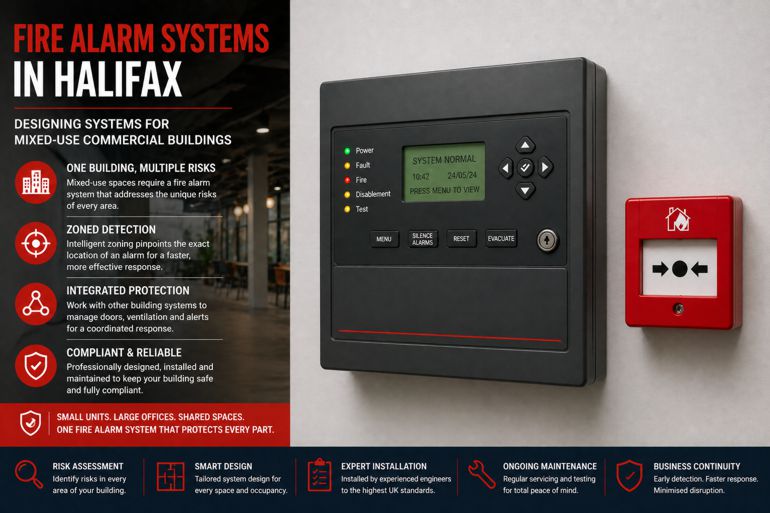
Mixed-Use Buildings –
In Halifax, many commercial properties are no longer single-purpose spaces. It’s increasingly common to see mixed-use buildings combining offices, retail units, storage areas and even residential elements within the same structure. While this is efficient from a property perspective, it creates a far more complex challenge when it comes to fire alarm system design.
A mixed-use environment introduces multiple risk profiles within one building. A ground floor retail unit may involve high footfall and electrical equipment, while upper floors may house offices with lower risk levels. Storage areas or plant rooms introduce entirely different hazards again. A fire alarm system in Halifax must account for all of these variables without becoming overly complicated or prone to false alarms.
The starting point is always a comprehensive fire risk assessment. This identifies how each area of the building is used, what fire risks are present and how those risks interact. Without this foundation, any fire alarm system is likely to be either under-specified or unnecessarily complex.
Zoning is one of the most important aspects of system design in mixed-use buildings. Each area should be divided into clearly defined zones, allowing the system to identify exactly where an alarm has been triggered. In Halifax premises with multiple tenants or functions, zoning allows for quicker investigation and a more controlled response.
Different detection methods must be used throughout the building. For example, smoke detectors may be suitable in office areas, while heat detectors are more appropriate in kitchens or plant rooms. In retail environments, detector placement must account for lighting, displays and airflow, all of which can affect performance.
System integration becomes particularly valuable in mixed-use settings. Fire alarms can be linked to other building systems to support a coordinated response. This might include releasing access-controlled doors, shutting down ventilation systems or triggering alerts to specific areas of the building.
Another key consideration is evacuation strategy. In some mixed-use buildings, a full evacuation may be required, while in others a phased evacuation is more appropriate. The fire alarm system must support this strategy, ensuring that alerts are communicated clearly and effectively.
For buildings with multiple occupants or tenants, system management is also important. Responsibilities must be clearly defined, including who is responsible for maintenance, testing and responding to alarms. In Halifax, where many mixed-use buildings involve shared spaces, this clarity is essential.
False alarm management is particularly important in these environments. With different activities taking place in different areas, the risk of unwanted activations increases. Correct detector selection, careful positioning and proper system configuration all help reduce this risk.
Maintenance must be consistent across the entire system. All components should be serviced regularly in line with relevant standards to ensure reliability. In mixed-use buildings, this often requires coordination between different users or tenants.
Access to equipment is another consideration. Control panels, call points and detectors must be accessible for maintenance and testing, while still being protected from misuse or damage.
Staff awareness and training should not be overlooked. Occupants of the building should understand how to respond to alarms, including evacuation procedures and basic system awareness. In shared buildings, this ensures a consistent and effective response.
Documentation is critical for both compliance and ongoing management. Records of system design, maintenance and testing help ensure that the system remains effective and can be reviewed as needed.
As buildings evolve, fire risks can change. New tenants, layout changes or changes in use can all impact fire safety requirements. Regular reviews ensure that the fire alarm system continues to meet the needs of the building.
For businesses and property managers in Halifax, fire alarm systems in mixed-use buildings require a more considered approach. By focusing on zoning, appropriate detection, integration and ongoing management, it is possible to create a system that is both compliant and practical.
Ultimately, the goal is to ensure that every part of the building is protected appropriately, without unnecessary complexity or disruption. A well-designed fire alarm system provides clarity, reliability and confidence — even in the most complex environments.