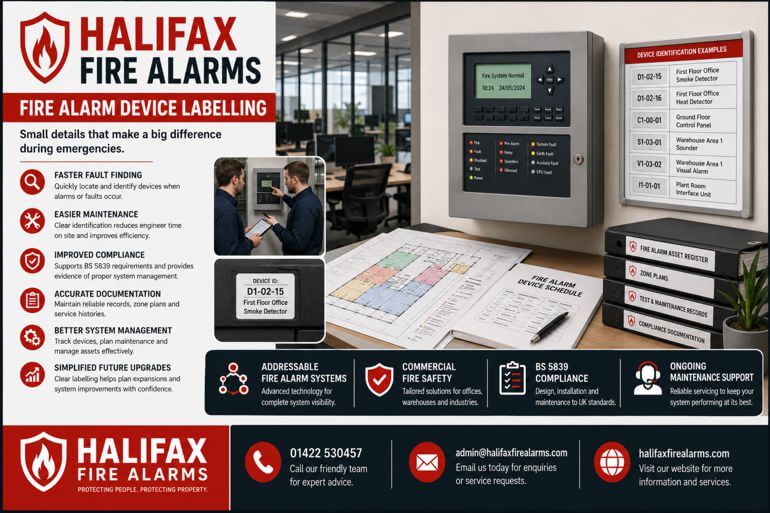
Fire Alarm Device Labelling –
When businesses think about fire alarm systems, attention is usually focused on detectors, control panels, sounders and maintenance schedules. However, one often-overlooked aspect of fire alarm management is device labelling.
Whilst labels may seem like a minor detail, clear and consistent identification of fire alarm equipment can significantly improve maintenance efficiency, fault finding, emergency response and overall system management.
Across Halifax, many commercial buildings have expanded and evolved over the years. Offices have been reconfigured, warehouses extended and departments relocated. Unfortunately, fire alarm documentation and device identification do not always keep pace with these changes.
A properly labelled fire alarm system can help eliminate confusion and provide valuable information when it matters most.
What Is Fire Alarm Device Labelling?
Device labelling involves assigning unique identification references to fire alarm components throughout a building.
These labels may be applied to:
• Smoke detectors
• Heat detectors
• Manual call points
• Sounders
• Visual alarm devices
• Interface units
• Control panels
• Power supplies
The objective is to allow every component within the system to be identified quickly and accurately.
Rather than referring to “the detector near the warehouse office”, engineers and responsible persons can refer to a specific device number.
Why Accurate Identification Matters
When a fire alarm fault occurs, engineers need to locate the affected device quickly.
In larger commercial premises, this can be difficult if there is no clear identification system in place.
Accurate labelling helps:
• Speed up fault diagnosis
• Reduce engineer time on site
• Improve maintenance efficiency
• Simplify system testing
• Support compliance records
For businesses operating across multiple floors or large industrial sites, these benefits can be substantial.
Supporting Emergency Procedures
During a fire incident, every minute matters.
If a detector activates repeatedly or a specific area generates an alarm condition, building managers need confidence that they are investigating the correct location.
Device identification helps maintenance teams and responsible persons correlate information shown on the fire alarm control panel with physical equipment within the building.
This can improve decision-making and reduce confusion during incidents.
Assisting Future Maintenance
Many commercial fire alarm systems remain in service for decades.
Over that time, multiple engineers, contractors and facilities managers may become involved with the building.
Without clear device identification, knowledge can be lost when personnel change.
A well-labelled system creates consistency regardless of who is maintaining or managing the premises.
This makes future servicing and modifications far easier to undertake.
Building Alterations Create Challenges
Commercial buildings rarely remain static.
Businesses expand, office layouts change and new areas are created.
Without an organised approach to device identification, these changes can create confusion within the fire alarm system.
Common issues include:
• Duplicate detector references
• Missing documentation
• Incorrect device locations
• Unclear zone information
• Conflicting maintenance records
A structured labelling strategy helps avoid these problems and ensures records remain accurate as the building evolves.
Supporting Fire Alarm Documentation
Fire alarm records should work alongside physical device identification.
Maintenance logs, zone plans and servicing reports all become more valuable when individual devices can be identified clearly.
This allows businesses to track:
• Maintenance history
• Detector replacements
• Fault trends
• Device testing records
• Future upgrade requirements
The result is better visibility of the entire fire alarm infrastructure.
Improving System Upgrades
When fire alarm upgrades become necessary, accurate device identification can significantly reduce project complexity.
Engineers can quickly assess:
• Existing equipment
• Device quantities
• Installation locations
• Expansion opportunities
• End-of-life components
This information helps businesses make informed decisions regarding future investment in fire safety systems.
A Low-Cost Improvement With Long-Term Benefits
Compared with major fire alarm upgrades, device labelling is a relatively small investment.
However, the operational benefits can continue throughout the life of the system.
Businesses gain:
• Better system visibility
• Faster maintenance
• Improved documentation
• Easier fault finding
• Greater compliance support
For larger commercial buildings, these benefits can quickly outweigh the modest cost of implementation.
Commercial Fire Alarm Services in Halifax
At Halifax Fire Alarms, we design, install, maintain and upgrade commercial fire alarm systems throughout Halifax and the surrounding areas.
Our engineers can assist with fire alarm surveys, documentation reviews, system upgrades and device identification programmes that help businesses improve maintenance efficiency and maintain compliance.
Whether you operate offices, warehouses, schools, industrial premises or multi-occupancy commercial buildings, we can help ensure your fire alarm system remains organised, compliant and easy to manage for years to come.