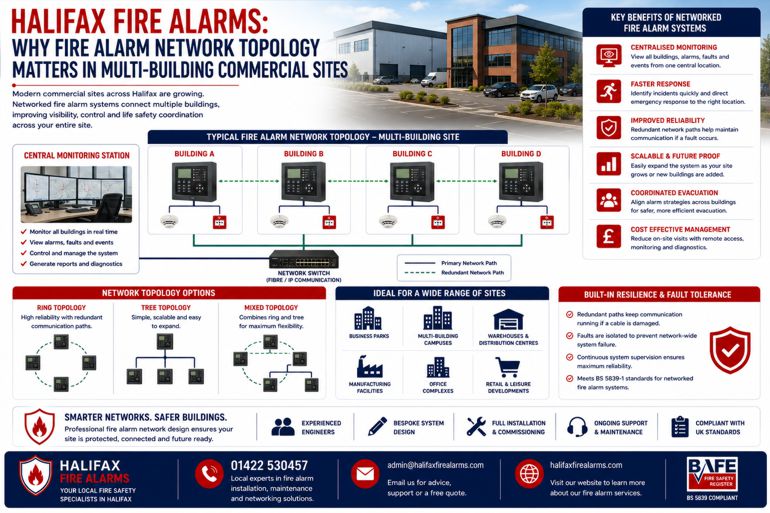
Fire Alarm Network Topology –
As commercial sites across Halifax continue expanding, many businesses now operate across:
- multiple buildings
- linked warehouses
- detached offices
- production units
- and distributed operational spaces
Managing fire alarm systems across these larger sites requires more than standalone control panels alone. Increasingly, businesses are using networked fire alarm topology to improve system visibility, control and life safety coordination across multiple buildings.
Modern networked systems allow separate fire alarm panels to communicate intelligently while still maintaining individual building functionality.
What Is Fire Alarm Network Topology?
Network topology refers to the way multiple fire alarm panels and devices are connected together across a site.
Rather than operating as isolated systems, networked fire alarms can:
- share event information
- display alarms centrally
- coordinate evacuation strategies
- and improve overall site management
Multi-Building Sites Create Additional Challenges
Commercial campuses often contain:
- separate occupancy types
- varying fire risks
- different operating hours
- and multiple evacuation zones
Without proper integration, managing incidents across several buildings may become more complicated.
Centralised Monitoring Improves Visibility
Networked systems can allow facilities teams to:
- monitor multiple buildings
- identify alarm locations quickly
- and manage faults centrally
from a single location.
This can improve:
- response times
- incident awareness
- and operational oversight
particularly on larger commercial sites.
Different Buildings May Require Different Configurations
A warehouse may require:
- industrial detection
- high-level sounders
- or staged evacuation
while adjacent office spaces may use:
- standard commercial detection
- public access areas
- and different evacuation procedures
Networked topology allows buildings to maintain appropriate individual configurations while remaining interconnected.
Redundancy Improves System Resilience
Certain network structures provide alternative communication paths if:
- wiring faults occur
- network segments fail
- or individual panels lose connectivity
This helps improve:
- reliability
- fault tolerance
- and overall system resilience
Large Sites Often Expand Over Time
Commercial premises frequently evolve through:
- extensions
- additional units
- warehouse growth
- and operational redevelopment
Flexible network topology helps businesses expand fire alarm infrastructure more efficiently as sites develop.
Security And Fire Systems May Also Integrate
Modern commercial buildings increasingly integrate fire alarms with:
- access control
- smoke control
- public address systems
- lift interfaces
- and building management systems
Networked fire alarm structures help support this broader systems integration.
Fault Monitoring Becomes More Important
Larger systems naturally contain:
- more devices
- more cabling
- and more complex infrastructure
Advanced network monitoring helps engineers identify:
- communication issues
- panel faults
- or device failures
more efficiently.
Evacuation Strategies May Differ Across Buildings
Some sites may require:
- phased evacuation
- selective alarm routing
- or building-specific responses
depending on:
- occupancy
- operational risks
- and building layout
Networked systems help coordinate these strategies more effectively.
Professional Design Is Essential
Incorrect network design may create:
- communication instability
- fault propagation
- or operational complexity
Professional fire alarm engineering helps ensure:
- suitable network structure
- reliable communication
- and long-term scalability
Modern Commercial Fire Alarms Need Smarter Infrastructure
For businesses in Halifax, fire alarm systems are increasingly expected to support:
- larger sites
- multiple buildings
- operational flexibility
- and integrated safety management
Professional fire alarm network topology helps provide:
- improved visibility
- stronger resilience
- centralised monitoring
- and more effective multi-building fire protection
As commercial sites continue growing in scale and complexity, intelligent fire alarm networking is becoming an increasingly important part of modern life safety system design.
Frequently Asked Questions
What is fire alarm network topology?
It refers to how multiple fire alarm panels and systems are connected across a site.
Why are networked fire alarms useful?
They improve monitoring, coordination and system management across larger or multi-building premises.
Can networked systems improve reliability?
Yes. Certain network structures provide redundancy and improved fault tolerance.